Two compasses sit side by side on a shop counter and the difference looks like a matter of taste. One is a flat sheet of clear plastic with a needle floating in a bubble. The other is a folded metal case that opens like a pocket watch. Pick either one up, turn around, and the needle swings to north. So far, no contest.
The rest of the story shows up on a hillside in bad weather, with a map flapping and a ridge that might be the wrong ridge. That is where the two designs part company. The gap between a baseplate compass and a lensatic compass is not about quality. It is about what each was built to do, and how much of your navigation you plan to do with a map versus with your eyes on the ground.
Two Designs With Very Different Roots
The baseplate compass
A baseplate compass is a protractor bolted to a ruler. The clear acrylic plate has straight edges, printed scales for common map ratios, a magnifier, and often a romer for grid references. The capsule on top holds the magnetic needle and a rotating bezel with orienting lines and a direction-of-travel arrow. Better models let you set magnetic declination once with a small screw or slider so the map and the needle agree without mental arithmetic.
Every part of it assumes a map underneath. The transparent plate lets you see contour lines through it, and the straight edge lets you draw a bearing line from a hut to a col. The thumb compass used in orienteering is a stripped-down cousin of the same idea.
The lensatic compass
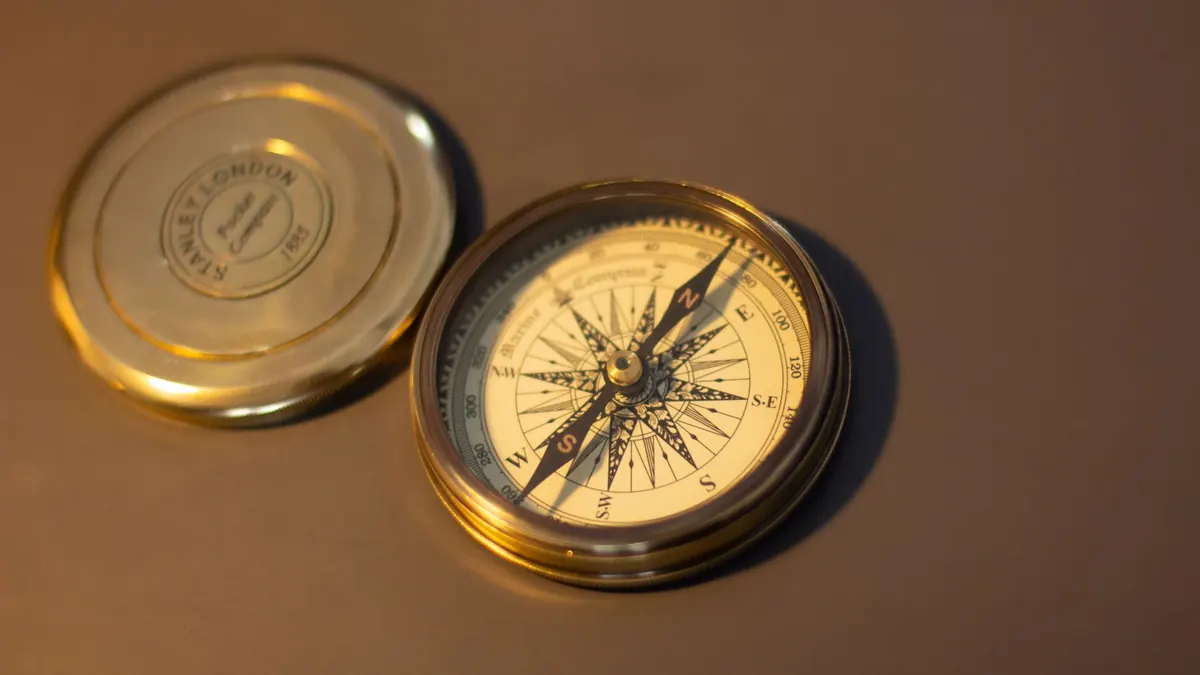
A lensatic compass is a sighting instrument. It folds into three parts: a cover with a fine sighting wire stretched across it, a body carrying the dial, and a rear sight with a lens and a notch. You line up the wire, the notch, and the distant object, then read the bearing under the lens without taking your eye off the target. Many dials are graduated in mils, and the markings glow so you can read them in the dark.
It was designed for people who needed a fast, repeatable bearing to a landmark, and who needed the instrument to survive being dropped on rock. Map plotting was never the priority.
Accuracy: Where the Difference Actually Shows
Both instruments are more accurate than the person holding them, most of the time. A well-made compass of either style will point you within a degree or two, and a careful user can do better. The errors that ruin a bearing rarely come from the compass.
They come from the environment and from handling. A phone in your chest pocket, a steel gatepost, a wire fence, a trekking pole laid against the map, a watch with a magnetic clasp — all of these bend the needle more than the design of the compass ever will. Standing under power lines or beside a vehicle is enough to throw you off by a wide margin.
Where the lensatic does have an edge is repeatability. The fixed front and rear sights force your eye into the same line every time, which matters when you are taking a bearing in wind, with gloves on, or in flat light. A plain baseplate held at chest height, sighting along the direction-of-travel arrow, introduces a few degrees of slop. Mirrored baseplate models close most of that gap by giving you a sighting line and a reflected dial.
Map Work: The Baseplate's Home Turf
If you navigate with a paper map, the baseplate wins without much argument. It is transparent, it has a straight edge, and it has scales printed on it. A lensatic compass is opaque and has no plotting edge, so you can set it down on a map and read a bearing, but you cannot draw through it or line it up against a grid line comfortably.
The standard baseplate workflow on a map looks like this:
- Lay the long edge of the baseplate along the line from where you are to where you want to go, with the direction-of-travel arrow pointing at the target.
- Turn the bezel until the orienting lines inside the capsule run parallel with the map's north-south grid lines, or with the meridian printed on the map.
- Read the bearing at the index line, then apply your declination — or set the declination on the compass once and forget it.
- Hold the compass flat in front of you and turn your whole body until the red end of the needle sits inside the orienting arrow.
- Walk on the direction-of-travel arrow, picking a feature ahead to head for rather than staring at the needle.
That loop — map to compass to ground — is the core skill of land navigation, and the baseplate is shaped for it.
Field Bearings: The Lensatic's Case
Flip the situation. No convenient line of sight to a mapped feature, or a target you can see but cannot identify on the map. You need an azimuth to a distant cairn, a gap in a cliff line, a building on a horizon.
With a lensatic, you raise it to your eye, align the sighting wire and the notch on the target, and read the dial under the lens. The compass-to-cheek method, resting the body against your cheekbone for stability, gives you a steady hold and a clean read. It is quick, it works in poor light, and it is easy to teach. In open, featureless country — moorland, dunes, snow — that precision is worth carrying a heavier instrument for.
A baseplate can do the same job with practice, sighting along the edge or using a mirror, but it asks more of you. On a wooded trail with a clear map, that extra precision is not doing any work.
Size, Weight, and How It Packs
A baseplate compass is thin and light enough to vanish. It slides into a map case, a hipbelt pocket, the lid of a pack, or the chest pocket of a shell, and you forget it is there. That matters more than any spec sheet, because the compass you actually use is the one that is always within reach. The trade-off is durability: acrylic baseplates can crack if you sit on them, and the capsule fluid can develop a bubble after a hard knock.
A lensatic is a lump. It needs a pouch or a padded corner, and you will notice it on a light pack. In exchange it takes abuse that would destroy a plastic compass, and the glowing dial is genuinely useful at dusk and at night.
Which One Belongs in Your Pack
Match the tool to the trips you actually take, not the trips you imagine:
- Day hikes and marked trails with a paper map: a baseplate compass, full stop. Light, cheap to replace, and built for the job.
- Map-heavy travel, orienteering, fast and light days: a thumb compass or a small baseplate worn on a lanyard, so it never leaves your hand.
- Open, featureless terrain where you take bearings on visible landmarks: a lensatic, or a mirrored baseplate if you want sighting precision without the weight.
- Land navigation courses and anything working in mils: a lensatic, since that is the graduation and the method you will be tested on.
- Paddling and cycling: a baseplate that can be strapped flat to a deck or a bar, where a folding sighting compass is awkward.
- Emergency kit: a tiny baseplate or a button compass, checked once a season.
Many experienced walkers carry a baseplate as their working compass and a small button compass as a backup, which covers the realistic failure modes without much weight.
Practical Tips Before You Buy
Handle both styles in the shop. Turn the bezel: it should click firmly and not drift. Watch the needle settle: a slow, sticky needle that takes ages to stop is a bad sign, and a large bubble in the capsule means a leak, though a tiny one is common and usually harmless. Check that the baseplate edges are straight and the printed scales are sharp. For a lensatic, open and close it a few times and make sure the sighting wire is taut and not bent.
At home, look up the magnetic declination for your area and set it on the compass if the model allows it. If it does not, write the value on your map case in pencil and decide once whether you are adding or subtracting it — most bearing errors come from muddling that step, not from the instrument.
Then go and practise somewhere low-stakes: a park, a trail junction, a car park with known features. Take a bearing, walk it, see where you end up. Ten minutes of that is worth more than any specification, and it will tell you quickly whether you are a baseplate person or a lensatic one.
Photo: Jaiju Jacob / Pexels